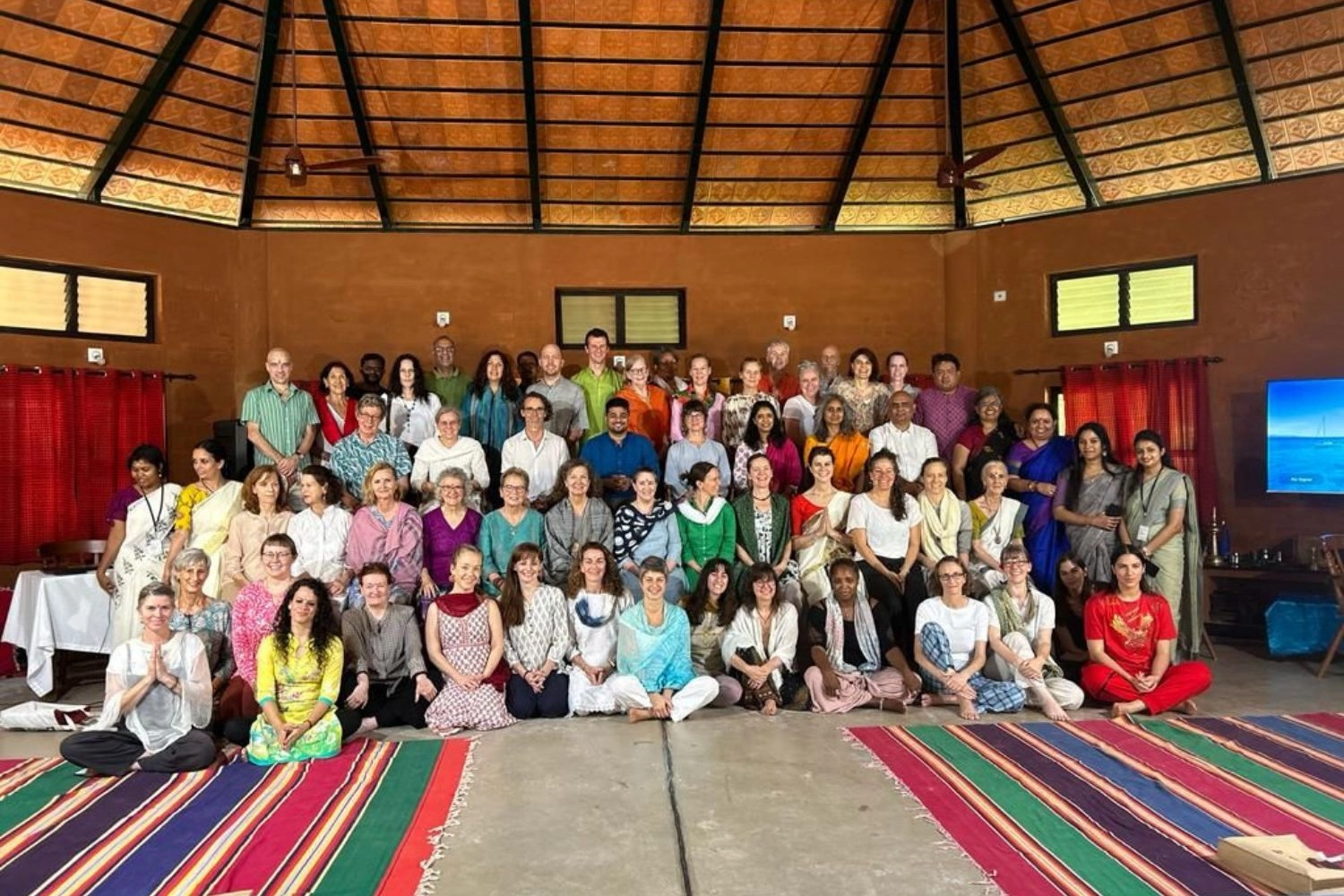
Vedic Threads | Recorded
Tāla
Rhythmic Measure in Art, Architecture, Music and Dance
This session explores tāla as a unifying principle of rhythm, proportion, and measurement across Indian arts, including music, dance, visual art, and architecture. It highlights how tāla provides structure and precision, shaping movement, sound, and form while allowing expression to unfold harmoniously. The discussion emphasizes the balance between technical accuracy and the flow of rasa, showing that true artistry arises when disciplined structure supports emotional experience. The reflection session deepens this by exploring relationships between rhythm, silence, and perception, encouraging an understanding of how underlying patterns and intervals bring meaning, beauty, and coherence to both art and daily life

Guest Instructor
Drdha Vrata Gorrick
Drdha Vrata Gorrick is a contemporary artist rooted in traditional Vedic arts, blending classical South Indian training with Western techniques. Born in the US, he spent over 15 years studying art and architecture in India, developing expertise in iconography, iconometry, painting, sculpture, and sacred design. His work seeks to elevate consciousness through devotional art, drawing inspiration from timeless temple traditions. Alongside creating commissioned works for homes and temples, he teaches through workshops and courses, sharing his knowledge and preserving traditional artistic wisdom. He also contributes as a guest instructor in Satsangam’s Vedic Threads program.

Guest Instructor
Vinay Srinivasan
Vinay Srinivasan has studied Bharatanatyam under Smt. Hema and Krithika Rajagopalan for 24 years and completed his Arangetram in 2007. He performs as a soloist and with Natya Dance Theatre at major venues in the U.S. and India, including Chennai’s December Music Festival. Known for crisp nritta and expressive abhinaya, his Carnatic music training deepens his connection to performance. A studio artist and student of Dravidian symbolism, Vinay connects dance, music, art, and philosophy as part of his spiritual growth, while working as a UX Designer in the Bay Area.
Session 1Tāla
Rhythmic Measure in Art, Architecture, Music and Dance with Drdha Vrata Gorrick & Vinay SrinivasanTopics Covered:
- Introduction to tāla as a unifying principle of rhythm, measure, and proportion across Indian arts
- Understanding tāla in music as rhythmic structure, meter, and emphasis
- Role of tāla in dance as the foundational timing that guides movement and expression
- Exploration of tāla in visual arts and architecture (tālamāna) as proportion and sacred measurement
- Connection between geometry, symmetry, and divinity in artistic creation
- Insights from śilpa śāstra and Nāṭyaśāstra in shaping artistic traditions
- Relationship between tāla, prāṇa (life force), and rasa (aesthetic experience)
- Balancing technical precision with expressive flow in artistic practice
Learning Objectives:
- Define tāla and understand its application across music, dance, and visual arts
- Identify ways in which tāla structures rhythm, proportion, and movement in Indian art forms
- Explore the relationship between tāla and rasa, and how structure supports aesthetic experience
Session 2
Reflections & Integration with the Instructors
Topics Covered:
- Integration of core concepts: svara (note), rāga (melodic framework), tāla (rhythm), rasa (experience), and ṛtam (cosmic order)
- Exploration of distance and space—between sounds, thoughts, and beings—as essential to meaning and harmony
- Understanding how structure (measurement) can both support and limit the experience of rasa (feeling)
- The idea of a “window to the divine” that emerges through and beyond structure
- Reflections on practice and discipline as pathways to spontaneous expression
- Stories and examples from Indian classical music and dance traditions
- Insights into gati (movement/flow) and its role in rhythm and life
- The importance of silence and pause in creating meaning—“music exists between the notes”
Learning Objectives:
- Understand and define key concepts: svara, rāga, tāla, rasa, ṛtam, and kāma
- Identify the interrelationships between these elements in art and experience
- Reflect on the role of rhythm, distance, and silence in shaping perception and meaning
About Vedic Threads
Every Indian wisdom tradition carries within it a vast web of ideas, stories, and living knowledge. Vedic Threads is an invitation to explore that web — one theme at a time, in the company of lifelong practitioners and sincere seekers from around the world. Join hosts Drs. Ramkumar and Claudia Welch and Navneet Raman, and our distinguished guest instructors, for conversations that deepen your understanding of Ayurveda, yoga, and the traditions they emerge from.
Vedic Threads | Recorded
The Heart & The Mind
This session explores the relationship between manas (mind) and hṛdaya (heart) through Ayurvedic, yogic, and bhakti perspectives. It presents the heart as the subtle seat of consciousness and the root of the mind, with the mind acting as a moving, sense-driven faculty. Through metaphors and teachings, the session highlights the importance of shifting from reactive thinking to witnessing awareness, allowing the mind to be guided by the deeper intelligence of the heart. Ultimately, it emphasizes inner integration—where clarity, love, and perception align—inviting a more conscious, centered way of experiencing life and responding to the world.

Guest Instructor
Neha Tiwari
Neha Tiwari is a language educator and scholar with a deep passion for linguistics, literature, and Indian knowledge systems. A graduate of IIT Kanpur, she has spent over a decade teaching languages such as Hindi, Urdu, Awadhi, Sanskrit, and Persian to a global audience. Her work bridges language learning with cultural and philosophical inquiry, reflecting her interest in both ancient and modern systems of knowledge. Through her teaching and continued studies, she fosters a nuanced understanding of language as a gateway to deeper intellectual and experiential exploration.

Guest Instructor
Laura Clarke Stelmok
Laura Clarke Stelmok earned a BA from Bowdoin College and an MA in Acupuncture from the Worsley Institute and College of Traditional Acupuncture. In private practice since 1992, she studied with JR Worsley and later returned to Taoist medicine and the Songs of Creation. In 2012, at the request of Sufi teacher Llewellyn Vaughan-Lee, she founded The Unseen Hand: Medicine from Antiquity, a nonprofit school preserving a living esoteric tradition of healing, mystical feminine wisdom, and teacher-to-student transmission.
Session 1The Heart & The Mind
with Neha TiwariTopics Covered:
- Exploration of manas (mind) and hṛdaya (heart) in Indian wisdom traditions
- Understanding that mind and heart are sometimes interconnected, yet distinct in function
- Manas as a sensory, moving, attention-driven faculty that follows perception
- Hṛdaya as an inner, subtle space—a “cave” where deeper awareness and truth reside
- The root of the mind in the heart, with channels (nāḍīs) extending throughout the body
- Classical metaphors: chariot model from the Bhagavad Gita and insights from the Upaniṣads
- The idea of witness consciousness—choosing awareness over reactivity
- The relationship between hṛdaya, ṛtam (cosmic order), and love as a transformative force
Learning Objectives:
- Define manas (mind) and hṛdaya (heart) and understand their distinct roles
- Describe the relationship and interaction between heart and mind in experience
- Reflect on how awareness, attention, and inner perception shape one’s inner life
Session 2
Reflections & Integration with the Instructors
Topics Covered:
- Exploration of the relationship between mind and heart through a Sufi lens
- Understanding the heart as the center of love, truth, and divine connection
- The mind as something that must be “brought into” or rooted in the heart
- The process of “polishing the heart”—clearing emotional and mental impurities
- The role of longing (bhakti) as a force that refines and purifies the mind
- Insight that true knowing arises from the heart, not just intellectual thought
- The importance of breath and practice in connecting mind and heart
- Recognition that spiritual growth may involve struggle, surrender, and simplification of the mind
Learning Objectives:
- Reflect on the relationship between the mind and the heart from experiential and spiritual perspectives
- Understand the role of love, longing, and purification in integrating mind and heart
- Explore what it means to experience alignment between heart and mind in one’s own life
About Vedic Threads
Every Indian wisdom tradition carries within it a vast web of ideas, stories, and living knowledge. Vedic Threads is an invitation to explore that web — one theme at a time, in the company of lifelong practitioners and sincere seekers from around the world. Join hosts Drs. Ramkumar and Claudia Welch and Navneet Raman, and our distinguished guest instructors, for conversations that deepen your understanding of Ayurveda, yoga, and the traditions they emerge from.
Vedic Threads | Recorded
Kalā, Rasa and Rasika
The Arts & The Lovers
This session explores the relationship between kalā (art or skill), rasa (emotional essence), and rasika (the one who experiences it), presenting art as a pathway to self-transformation. Navneet Raman emphasizes that true engagement with art involves dissolving the ego and becoming fully immersed in the experience, where the artist and observer merge. Through consistent practice and refinement, one evolves from creating or observing art to embodying it. The session highlights that life itself is an expression of kalā, and through openness, humility, and devotion, one can cultivate deeper sensitivity, joy, and connection with the world.

Guest Instructor
Navneet Raman
Navneet Raman is a cultural preservationist and arts patron from a historic Varanasi family deeply rooted in India’s educational and cultural legacy. For over two decades, he has worked to sustain and evolve the city’s heritage through initiatives in art, education, and conservation. He is the founder of Kriti Gallery and Artist Residency, co-founder of the Banaras Cultural Foundation, and Creative Director of the Banaras Museum of Contemporary Art. His work bridges traditional crafts and contemporary art, supporting global exhibitions and artisans. Through educational programs and cultural collaborations, he continues to foster interdisciplinary learning and preserve Varanasi’s living heritage.
Session 1Kalā, Rasa and Rasika
The Arts & The Lovers with Navneet RamanTopics Covered:
- Introduction to kalā (arts/skills) as both creative expression and essential life practices
- Understanding rasa (emotional essence or flavor) as the experience evoked through art
- Exploration of rasika (the connoisseur or experiencer of rasa)
- Insight into the interdependence of artist, art, and audience in creating meaning
- The role of guru as a guide to perceiving the divine through art and life
- Connection between kalā and everyday life, from practical skills to refined arts
- The idea of losing the ego/self in the experience of rasa
- Reflection on practice (sādhana) as a path to becoming a true rasika
- Understanding the relationship between karma, intention, and artistic expression
Learning Objectives:
- Define kalā, rasa, and rasika
- Understand the relationship between art, experience, and the perceiver
- Reflect on how engagement with art can become a path of self-transformation and awareness
Session 2
Reflections & Integration with the Instructors
Topics Covered:
- Continuation of exploration of kalā, rasa, and rasika from the previous session
- Deepening understanding of the 16 kalās of Lord Krishna and their relation to the broader 64 kalās
- Reflection on the evolution and refinement of skills as a spiritual journey
- Exploration of śraddhā (faith) and sandeha (doubt) in the learning process
- Distinction between superficial questioning and sincere, inquiry-driven seeking
- The role of music and bhajan in transmitting rasa and devotion
- Insights into living traditions of Banaras, where wisdom is embedded in daily life
- Emphasis on intentional practice and inner transformation through engagement with kalā
Learning Objectives:
- Understand the relationship between the 16 and 64 kalās and their symbolic significance
- Reflect on the role of faith (śraddhā) and inquiry in the process of learning and refinement
- Explore how practice of kalā can lead to deeper self-awareness and spiritual growth
About Vedic Threads
Every Indian wisdom tradition carries within it a vast web of ideas, stories, and living knowledge. Vedic Threads is an invitation to explore that web — one theme at a time, in the company of lifelong practitioners and sincere seekers from around the world. Join hosts Drs. Ramkumar and Claudia Welch and Navneet Raman, and our distinguished guest instructors, for conversations that deepen your understanding of Ayurveda, yoga, and the traditions they emerge from.
Vedic Threads | Recorded
Rāga Cikitsa
Desire as Cause or Cure of Disease?
This session explores the dual meaning of rāga as both desire (a root cause of disease) and musical expression (a potential tool for healing). Dr. Shubham Kulkarni explains how attachment and emotional patterns disturb mental balance, while rāga in music can restore harmony through sound and vibration. Integrating Ayurveda and Indian classical music, he presents rāga cikitsā as a therapeutic approach for conditions like insomnia, anxiety, and depression. The session highlights how conscious engagement with sound can transform emotional states, showing that what causes imbalance can also become a pathway to healing and inner alignment.

Guest Instructor
Dr. Shubham Kulkarni
Dr. Shubham Kulkarni is an Ayurvedic doctor and music therapist specializing in end-of-life care and mental health. He serves as the Head of the Department of Gandharva Veda Music Therapy at Maharishi University in the Netherlands and is a fellow of Naad, Raag, Ras, and Consciousness rooted in Abhinavgupta’s philosophy. A trained classical vocalist and disciple of Pandit Shounak Abhisheki ji, his work integrates both clinical and philosophical research, focusing on areas such as insomnia, depression, pregnancy care, Shaivism, tantra, mental health, and end-of-life care, alongside extensive clinical practice and tutoring experience across more than six countries.
Session 1Rāga Cikitsa
Desire as Cause or Cure of Disease? with Dr. Shubham KulkarniTopics Covered:
- Exploration of rāga as both desire (attachment) and musical expression
- Understanding rāga in Ayurveda as a root cause of disease when it manifests as attachment
- Reframing rāga in music as a potential tool for healing (cikitsā)
- Insight into mental health from an Ayurvedic perspective
- The dual nature of desire—that which binds and that which can liberate
- Use of Indian classical music as therapy, influencing emotional and physiological states
- Practical examples of rāga cikitsā in conditions like insomnia, depression, pregnancy, and end-of-life care
- Integration of ancient wisdom and modern scientific perspectives on music therapy
Learning Objectives:
- Understand the concept of rāga in both Ayurvedic and musical contexts
- Explore how desire can act as both a cause and a cure of disease
- Gain insight into the use of rāga cikitsā as a therapeutic tool for mental and emotional well-being
Session 2
Reflections & Integration with the Instructors
Topics Covered:
- Continued exploration of rāga as both cause (desire/attachment) and cure (music/therapy)
- Insights from the Bhagavad Gita on desire and its relationship to the mind
- Understanding the interplay between mind, desire, and emotional states
- Introduction to Indian Classical Music systems—Hindustani (North) and Carnatic (South)
- Exploration of the structure and components of a rāga
- The role of khayāl (imagination, interpretation) in musical expression
- Understanding svara as both musical note and expression of breath/life force
- Connection between Vedic knowledge and the origins of rāga
Learning Objectives:
- Define svara and understand its dual role in music and breath
- Differentiate between the two major systems of Indian classical music
- Explore how desire (rāga) influences the mind, drawing from the Bhagavad Gita
About Vedic Threads
Every Indian wisdom tradition carries within it a vast web of ideas, stories, and living knowledge. Vedic Threads is an invitation to explore that web — one theme at a time, in the company of lifelong practitioners and sincere seekers from around the world. Join hosts Drs. Ramkumar and Claudia Welch and Navneet Raman, and our distinguished guest instructors, for conversations that deepen your understanding of Ayurveda, yoga, and the traditions they emerge from.
Vedic Threads | Recorded
Mantra through Vedic Chanting vs. Kirtan
This session explores the nature of mantra as a transformative tool that guides the mind toward clarity and inner alignment. Shantala Sriramaiah and Nina Rao distinguish between Vedic chanting—requiring precision, lineage, and correct intonation—and kirtan, which emphasizes devotion, emotion, and accessibility. While Vedic mantras aim to replicate divine revelation through exact recitation, kirtan offers a more spontaneous, heart-centered expression of bhakti. Together, both approaches highlight mantra as a bridge between mind and the divine, showing that whether through discipline or devotion, sound can purify awareness and deepen spiritual connection.

Guest Instructor
Nina Rao
Nina Rao is a renowned kirtan singer and teacher whose journey began with learning devotional chants from her grandfather in South India. After reconnecting with chanting through Krishna Das in 1996, she became both his longtime collaborator and business manager. Her music, including albums like Antarayaami and Anubhav, reflects a deep commitment to bhakti and sacred sound. Based in New York, she leads kirtans, workshops, and retreats globally. Beyond music, she is the chairwoman of Saving Wild Tigers and hosts a podcast exploring spirituality, practice, and environmental conservation.

Guest Instructor
Shantala Sriramaiah
Shantala Sriramaiah is a dedicated teacher of Vedic chanting, carrying forward a living lineage of Sanskrit recitation from Karnataka, India. Inspired by her mother, who taught chanting for over 30 years, she developed an early and deep connection to Vedic traditions. Mentored by esteemed scholars including Sri M.S. Sreenivasan of the Challakere Brothers, she emphasizes precision, discipline, and authenticity in her teaching. Through her online platform and live classes, she shares Veda recitation with a global community. She also played a foundational advisory role in the early years of Satsangam, continuing as a valued guide and contributor.
Session 1Mantra through Vedic Chanting vs. Kirtan
with Shantala Sriramaiah & Nina RaoTopics Covered:
- Introduction to mantra as an instrument of thought that guides the mind toward clarity and the divine
- Distinction between Vedic mantra (precise, revealed, structured) and kīrtan/bhajan (devotional, expressive, musical)
- Importance of accuracy, pronunciation, and intonation (svara) in Vedic chanting
- Understanding nāma mantra (repetition of the divine name) as an accessible and powerful practice
- Exploration of mantra as both a personal (guru-given) and universal practice
- The relationship between discipline (vidhi bhakti) and spontaneous devotion (rāgātmika bhakti)
- Insight into mantra as a two-way process—offering and receiving from the divine
- Reflection on who can practice mantra and the inclusivity of different paths
Learning Objectives:
- Understand the definition and purpose of mantra
- Differentiate between Vedic chanting and kīrtan/bhajan practices
- Reflect on the importance of pronunciation, meaning, and intention in mantra practice
Session 2
Reflections & Integration with the Instructors
Topics Covered:
- Continued exploration of who is qualified to engage with mantra, Vedic chanting, and kīrtan
- Discussion on historical exclusions in certain texts and their impact
- Reflection on the idea that Vedic knowledge, at its essence, is not inherently exclusionary
- Understanding the role of lineage (paramparā) in preserving and transmitting knowledge
- Inquiry into practicing without formal lineage and the place of sincere intention
- Exploration of bhakti in its different forms: vidhi (structured), rāgātmika (spontaneous), and parā (transcendent)
- Importance of pronunciation vs. devotion in different practices
- Introduction to kavacha (protective mantras) and their role
Learning Objectives:
- Understand the complex historical and philosophical perspectives on who can practice Vedic chanting and kīrtan
- Define lineage (paramparā) and kavacha, and their roles in spiritual practice
- Reflect on the balance between precision, devotion, and accessibility in mantra and chanting practices
About Vedic Threads
Every Indian wisdom tradition carries within it a vast web of ideas, stories, and living knowledge. Vedic Threads is an invitation to explore that web — one theme at a time, in the company of lifelong practitioners and sincere seekers from around the world. Join hosts Drs. Ramkumar and Claudia Welch and Navneet Raman, and our distinguished guest instructors, for conversations that deepen your understanding of Ayurveda, yoga, and the traditions they emerge from.
Vedic Threads | Recorded
Śakti & Śri Vidya
This session explores śakti as the dynamic life force underlying all existence and śrī vidyā as a path to realizing and harmonizing that energy within. Dr. Rishi Manivannan explains how śakti operates through the body, mind, and consciousness, linking it with concepts like agni, ojas, and the cycles of the moon. The practice of śrī vidyā is presented as both external ritual and inner transformation, where devotion, discipline, and awareness help balance and channel energy. The session emphasizes understanding one’s capacity, cultivating inner fire responsibly, and integrating duality into unity, leading toward deeper self-awareness and spiritual alignment.

Guest Instructor
Dr. Rishi Manivannan
Dr. Rishi Manivannan is an Ayurveda and Siddha practitioner rooted in a traditional vishavaidya lineage, with extensive training in both classical and esoteric Indian knowledge systems. Educated in Ayurveda (BAMS) and Chinese medicine (MD), he further studied under Siddha Yogi K.P. Arjunan in a gurukula setting, mastering disciplines such as Śaiva Tantra, Vāsi Yoga, Nāḍī Vidyā, Jyotiṣa, and Vāstu. Mentored by Padmashri P.R. Krishnakumar, he was initiated into Śrī Vidyā Tantra and the Aṣṭavaidya tradition. He now works toward establishing the “Garden of Peace,” integrating education, healing, and sustainability, while contributing to research bridging traditional medicine with modern science.
Session 1Śakti & Śri Vidya
with Dr. Rishi ManivannanTopics Covered:
- Introduction to śakti as the dynamic life force and śrī vidyā as a path of its realization
- Understanding the relationship between śakti (energy) and śrī (refined, auspicious expression of that energy)
- The body as a living field where śakti moves, manifests, and is worshipped
- Exploration of inner and outer worship—rituals as well as internal cultivation
- The concept of 16 kalās and 16 āvaraṇas as layers of consciousness to be refined or transcended
- Relationship between śakti and agni (fire)—both as transformative and potentially overwhelming forces
- Importance of balancing intensity (tapas) with cooling, sustaining practices
- Insight into Ardhanārīśvara and the unity of Śiva–Śakti
- Emphasis on self-awareness of capacity in spiritual practice to avoid imbalance or burnout
Learning Objectives:
- Define śrī vidyā and understand its place within spiritual and Ayurvedic frameworks
- Recognize key aspects of śakti and its expression in the body, mind, and practice
- Understand the different meanings of kalā across Ayurveda, arts, and śrī vidyā
Session 2Reflections & Integration
Topics Covered:
- Exploration of iḍā and piṅgala nāḍīs and differing interpretations across traditions
- Understanding how duality (male–female, sun–moon, expansion–contraction) is expressed in various knowledge systems
- Inquiry into reconciling contradictions between Ayurveda, Siddha, and other traditions
- The relationship between śakti and the language of duality
- Reflection on how prāṇa and śakti are experienced in the body and mind
- Insight into alignment (sura) vs. misalignment (asura) with the natural flow of life force
- Continued exploration of kalā and subtle energetic frameworks
- Emphasis on the role of a guru in navigating deeper engagement with śakti
Learning Objectives:
- Understand the fundamental dual forces that underlie nature and their expressions
- Compare how different traditions interpret energetic polarity and duality
- Reflect on one’s own experience of prāṇa and śakti in body and awareness
About Vedic Threads
Every Indian wisdom tradition carries within it a vast web of ideas, stories, and living knowledge. Vedic Threads is an invitation to explore that web — one theme at a time, in the company of lifelong practitioners and sincere seekers from around the world. Join hosts Drs. Ramkumar and Claudia Welch and Navneet Raman, and our distinguished guest instructors, for conversations that deepen your understanding of Ayurveda, yoga, and the traditions they emerge from.
Vedic Threads | Recorded
Prāṇa vs Śakti
This session explores the relationship between prāṇa and śakti, presenting them as interconnected yet distinct aspects of life force. Prāṇa is described as the vital breath or animating force sustaining life, while śakti is the deeper dynamic energy or creative power behind all movement and transformation. Through perspectives from Ayurveda, tantra, and embodied practices, the session highlights how prāṇa becomes effective when infused with awareness, and how śakti underlies all expression, from physical action to spiritual evolution. Together, they reveal a unified field of energy that shapes both individual experience and universal creation.

Guest Instructor
Dr N.Gopalakrishnan
Dr. N Gopalakrishan, an award winning research scientist in plant biochemistry, and international presenter, is also an acclaimed scholar in Indian knowledge systems. He has created a National Heritage Center in Thrissur, Kerala, India. His area of special interest is the Vedas. He has authored more than 150 books on different areas of Indian Knowledge systems. He is a guest instructor on Satsangam’s Vedic Threads membership-based online course.

Guest Instructor
Dr N.Gopalakrishnan
Dr Svoboda has been worshipping Shiva and meditating in cemeteries and cremation grounds for more than fifty years. He has personally cremated five people and has visited Benaras every year between 1984 & 2020. He is headed there again next month. He has also been intimately involved, as co-executor or something similar, with the estates of multiple people including his mentor, his mentor’s foster daughter and his parents.

Guest Instructor
Dr Robert Svoboda
Carolina Prada is a Colombian practitioner of Odissi, Mayurbhanj Chhau, and Kalaripayattu who has lived and trained in India since 2008. One of the few female soloists of her generation to professionally perform and teach both the male and female styles of Mayurbhanj Chhau under Guru Janmejoy Sai Babu, she has also studied Odissi under leading gurus of the Srijan tradition and trained in Kalaripayattu at Kalarigram. Her work bridges dance, martial practice, and spiritual discipline, and she has performed at major festivals in India and abroad while pioneering these traditions in Colombia through her company, OdissiYaatra.
Session 1Prāṇa vs Śakti
with Dr. GopalakrishnanTopics Covered:
- Introduction to prāṇa (life force) and śakti (dynamic energy) as foundational concepts
- Exploration of the relationship and distinction between prāṇa and śakti
- Understanding prāṇa as the animating force of life and śakti as the power behind manifestation and transformation
- Exposure to multiple layers and interpretations rather than fixed definitions
- Emphasis on experiential understanding over intellectual clarity
- Encouragement to reflect on one’s personal relationship with these concepts
Learning Objectives:
- Define prāṇa and śakti in a foundational way
- Understand that both concepts are multi-layered and context-dependent
- Begin to reflect on one’s own experiential understanding of life force and energy
Session 2Prāṇa vs Śakti
with Dr. Robert Svoboda & Carolina PradaTopics Covered:
- Exploration of prāṇa and śakti across disciplines—Ayurveda, dance (Odissi), and martial arts (Kalaripayattu)
- Understanding śakti as divine feminine energy (Devi, Ma) and creative force
- Insight into prāṇa as breath infused with awareness
- Relationship between prāṇa (life force) and śakti (power of manifestation)
- Role of body, space, and discipline in cultivating connection with śakti
- Preparing the body-mind to receive and embody subtle energies
- Introduction to Śrī Vidyā and Śakta traditions
- Exploration of interconnectedness between matter, elements, and life force
Learning Objectives:
- Develop a personalized understanding of prāṇa and śakti
- Understand the relationship between prāṇa, śakti, and embodied practices
- Gain introductory awareness of Śrī Vidyā and Kalaripayattu as pathways of practice
Session 3Reflections & Integration
Topics Covered:
- Continued exploration of prāṇa and śakti through direct experience and reflection
- Understanding how prāṇa and śakti are felt within the body and awareness
- Relationship between prāṇa–śakti and puruṣa–prakṛti (consciousness and nature)
- Exploration of kuṇḍalinī, vāta, and subtle energetic movement
- Inquiry into the role of posture and alignment in facilitating prāṇa flow
- Introduction to Kalaripayattu and its connection to Ayurveda and marma points
- Insights into the three śaktis: icchā (will), jñāna (knowledge), kriyā (action)
- Clarifying distinctions between ahaṃkāra (ego) and kuṇḍalinī śakti
- Understanding where śrī vidyā fits within Indian knowledge systems
Learning Objectives:
- Reflect on how prāṇa and śakti are experienced in one’s own body and awareness
- Understand the relationship between prāṇa, śakti, and broader philosophical frameworks
- Gain introductory insight into the connection between Ayurveda, marma, and Kalaripayattu
About Vedic Threads
Every Indian wisdom tradition carries within it a vast web of ideas, stories, and living knowledge. Vedic Threads is an invitation to explore that web — one theme at a time, in the company of lifelong practitioners and sincere seekers from around the world. Join hosts Drs. Ramkumar and Claudia Welch and Navneet Raman, and our distinguished guest instructors, for conversations that deepen your understanding of Ayurveda, yoga, and the traditions they emerge from.
Sample Pagesatsangam-webmin2023-01-09T18:02:17+00:00