Vedic Threads | Self paced
How Jyotish Empowers Self-Realization in Personal Art Forms
This session explores how jyotiṣa (Vedic astrology) can deepen self-realization and artistic expression by aligning creativity with time, space, and cosmic rhythms. Sudhir Pandey demonstrates how casting horoscopes for objects, moments, and actions transforms art into a sacred, intentional practice, where direction, timing, and pañcāṅga guide the creative process. The reflection session expands this into a broader awareness of space, orientation, and animism, encouraging participants to see everyday objects as alive and meaningful. Together, the sessions highlight living with greater sensitivity to time and environment, integrating ancient wisdom into art, perception, and daily life.
Guest Instructor
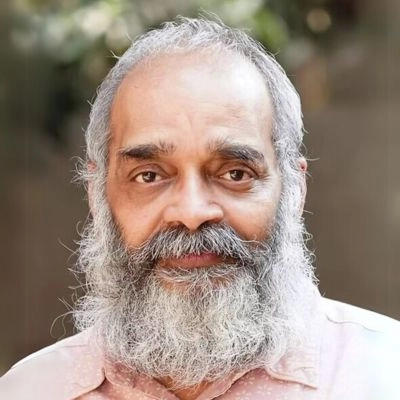
Sudhir Pandey
Sudhir Pandey is a Mumbai-based astrologer and artist who uniquely integrates jyotiṣa with visual art and creative expression. Trained at the Indian Council of Astrological Sciences and in the UK, he has practiced astrology since 2000, working with leading platforms like Ganeshspeaks. With a strong academic background in fine arts from MS University, Baroda—where he received a gold medal—his work bridges traditional wisdom and contemporary art. His international residencies and exhibitions reflect this synthesis, as he blends Vedic and Western astrology with artistic insight, offering a holistic, intuitive approach to both creative practice and personal consultation.
How Jyotish Empowers Self-Realization in Personal Art Forms with Sudhir Pandey
Topics Covered:
- Sudhirji began by sharing how studying art in France caused a cultural crisis, eventually leading him back to his Indian roots.
- He described his practice of casting horoscopes not just for people but for objects, events, and spaces.
- His art involves integrating astrological charts, symbols, and mantras with visual materials like mud, thread, plastic, and cultural relics.
- He links art and astrology through the idea that both activate and reflect time, space, and being.
- Colors in his work shift depending on the direction he faces while creating (e.g., east brings watery elements; west brings blue/black tones).
- He shared examples of works that anticipated real-world events, such as the 2005 Mumbai floods.
- Direction and timing (e.g., time of day, lunar mansion, planetary transits) play crucial roles in his creative process.
- He emphasized that jyotiṣa is not superstition, but a sacred science that brings structure and clarity to life and art.
- The pañcāṅga guides his daily practice and influences the art he creates on any given day.
- The session closed with a discussion about how modern artists and astrologers can bridge these ancient and contemporary frameworks.
Learning Objectives:
- Describe how Vedic astrology can be used to interpret and enrich personal artistic expression.
- Apply principles of directionality and timing (as per jyotiṣa) to creative practices for enhanced intentionality and meaning.
- Differentiate between traditional horoscope casting for people and the extended practice of casting for objects, moments, and creative processes.
Session 2
Reflections & Integration with the Instructors
Topics Covered:
- Sudhirji’s art practice uses the exact moment and direction he finds an object as an astrological key to inform his creation.
- Many participants resonated with the animist quality of his work—treating each object as alive, vibrant, and relational.
- The discussion naturally extended to vāstu, showing how direction, form, and spatial design deeply influence perception and energy.
- The concept of nimitta—omens in jyotiṣa—and how objects carry karmic significance when they arise in our awareness was explored.
- Claudia introduced the idea of consulting the pañcāṅga each day to understand the quality of time, and its practical role in Indian life.
- Dr. Ram Kumar ji shared that wisdom systems like Ayurveda and jyotiṣa are both sciences and arts—disciplines that are transcended through spiritual realization.
- Anastasia noted how awareness of the qualities of space and time brings art and life into alignment, inviting reflection on everyday sacredness.
- Participants reflected on how some powerful art is created by individuals in distress, suggesting that inspiration can come from deep suffering or thin veils between worlds.
- Leslie highlighted how orienting by landforms rather than left and right can connect us more intimately with the natural world.
- The session ended with a meditative exercise linking directions with elements, colors, mantras, and senses to illustrate the interconnectedness of Indian knowledge systems.
Learning Objectives:
- Identify and describe how direction, time, and orientation influence perception and practice in jyotiṣa and vāstu.
- Explain the concept of nimitta (omens) and how it reflects the living nature of objects within Vedic frameworks.
- Apply foundational elements of the pañcāṅga to explore how time is interpreted and experienced in the Vedic tradition.
About Vedic Threads
Every Indian wisdom tradition carries within it a vast web of ideas, stories, and living knowledge. Vedic Threads is an invitation to explore that web — one theme at a time, in the company of lifelong practitioners and sincere seekers from around the world. Join hosts Drs. Ramkumar and Claudia Welch and Navneet Raman, and our distinguished guest instructors, for conversations that deepen your understanding of Ayurveda, yoga, and the traditions they emerge from.