Vedic Threads | Self paced
Insights on Kullhad Economy and the Kullhad Economy Festival
This session explores Ajay Chaturvedi’s vision of time (kāla) as a cosmic, cyclical force rooted in natural rhythms like breath, sunrise, and planetary movement, contrasting it with modern linear clock-time shaped by industrial and colonial systems. He connects this Vedic understanding to the “Kullhad Economy,” a regenerative, decentralized model based on local production, sustainability, and alignment with nature. Emphasizing quality over branding, he critiques extractive economic systems and highlights the need to restore community resilience. The reflection session reinforces integrating these ideas through simple practices, encouraging a balanced, experiential relationship with time, intention, and daily living.

Guest Instructor
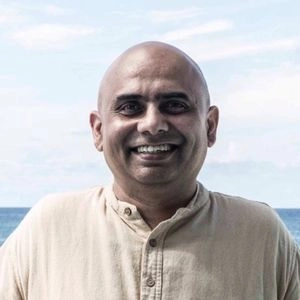
Ajay Chaturvedi
Prof. Ajay Chaturvedi is a distinguished thought leader bridging Vedic philosophy with modern strategy, economics, and systems design. A former Wall Street investment banker, he transitioned to develop the “Kullhad Economy,” a Dharmic model focused on regenerative production, local value creation, and sustainable prosperity. As a professor at IIT Mandi and IIM Rohtak, he integrates cosmology, consciousness, and governance into contemporary frameworks. His acclaimed works, including Time: The Trilogy of Time and Lost Wisdom of the Swastika, explore cosmic time, Yuga cycles, and civilisational balance. Educated at BITS Pilani, Wharton, Harvard, Oxford, and NUS, he brings a globally informed yet deeply rooted perspective.
Insights on Kullhad Economy and the Kullhad Economy Festival with Ajay Chaturvedi
Topics Covered:
- Time in Vedic knowledge is cosmic, cyclical, and based on natural rhythms like sunrise, tides, and breath.
- The mechanical clock and the 24-hour division of time stem from Vedic origins but were reinterpreted by colonial powers.
- Western economies begin with branding and then develop products; traditional Indian systems begin with high-quality production, and branding follows.
- Vedāṇga Jyotiṣa is essential to understanding not only astrology but the measurement of time itself.
- The invention of clock towers during colonization represented a claim to having conquered time.
- Panchāṇga (Vedic calendar) determines not just festivals, but the quality of time for every activity.
- Economic systems based on nature (kulhāṝ economy) are inherently sustainable and community-driven.
- Industrial standardization has reduced crop variety drastically in India, from over 200,000 types of rice to just 1,700.
- True health, longevity, and sustainability arise from syncing our breath, actions, and economy with nature.
- Decentralized, localized production revitalizes communities and offers economic resilience.
Learning Objectives:
- Identify and explain the Vedic concept of time (kāla) and its foundational role in spiritual and practical life.
- Distinguish between Western linear time constructs and cyclical, nature-based Vedic time systems.
- Evaluate how economic models grounded in nature and time awareness (“kulhāṝ economy”) differ from industrial marketing-driven economies.
Session 2
Reflections & Integration with the Instructors
Topics Covered:
- The group reflected on the previous session with Ajayji on time, economy and Jyotiṣa and agreed they would like several more sessions, possibly focusing on stories and specific strands like pañcāṅga and mahābhūta-s.
- Participants named topics they hope Ajayji will deepen: ancient stories about kāla, dimensions of time as a kind of multidimensional mapping, and how clock towers and standardized time reshaped culture and economics.
- Claudiaji situated the discussion in the Vedic cosmic timeline: kalpa (a day of Brahmā), manvantara (reign of a manu), mahāyuga (cycle of four yuga-s), and our current position under Vaivasvata manu in Kali-yuga.
- David questioned the common idea that “we are at the bottom,” noting that many traditions and eras feel they live in a fallen or deteriorating time, and wondered what it means for the aim of a human life if Kali-yuga is said to last a very long time.
- Judith and Jaruska offered a more hopeful lens: yuga-s can also be understood inside us; even in Kali-yuga connection to source may be simplest, and practices like chanting the divine name can be powerful despite—or because of—the density of the age.
- Several people spoke about the difference between information and transformation, and the need for space, repetition, story and even silence or meditation so that these teachings do not remain only in notebooks but can be digested and lived.
- Claudiaji shared the approach of letting vast teachings “wash over” us and then choosing one small thread to make spacious—using, for example, the saṅkalpa practice of placing ourselves in time and space as a practical way to relate to huge cosmic cycles.
- Ramkumarji explained the saṅkalpa mantra, which narrows from Brahmā’s time and cosmic geography down to Jambū-dvīpa, Bhārata-varṣa, a specific region and city, current pañcāṅga details, and then one’s concrete intention, bringing macro- and micro-cosmos to bear witness.
- Claudia then demonstrated how to read a daily online pañcāṅga: noting sunrise and sunset, different calendar systems, āmānta and pūrṇimānta months, the planetary lords of the weekdays, pakṣa (bright and dark fortnights), tithi and nakṣatra, and practical meanings such as suitability for certain kinds of actions.
- Ramkumarji added the deities and symbolic journey through the tithi-s—creation, growth, removal of obstacles, protection of subtle energy, building strength, movement toward source, destruction of ego and detachment—and closed by warning against fear or obsession with “bad times,” emphasising that prayer can make the inauspicious auspicious, and that every moment can be a living muhūrta.
Learning Objectives:
- Describe in simple terms at least three levels of Vedic time—kalpa, manvantara and yuga—and state where the current human era is placed within that map.
- Identify the five limbs of a pañcāṅga—vāra, tithi, nakṣatra, yoga and karaṇa—and give one concrete example of how a limb can shape a daily or ritual choice.
- Explain the purpose of the saṅkalpa mantra in locating oneself in time and space, and reflect on one personal way to relate to kāla with respect rather than fear or fixation.
About Vedic Threads
Every Indian wisdom tradition carries within it a vast web of ideas, stories, and living knowledge. Vedic Threads is an invitation to explore that web — one theme at a time, in the company of lifelong practitioners and sincere seekers from around the world. Join hosts Drs. Ramkumar and Claudia Welch and Navneet Raman, and our distinguished guest instructors, for conversations that deepen your understanding of Ayurveda, yoga, and the traditions they emerge from.